For injury & property practices
One altered photo can end the case. Know before you produce it.
Clients text you crash photos. Body shops email theirs. The other side produces more. ExhibitIQ checks every image for edits, wrong dates, stripped camera data and AI generation, so your team finds the problem at intake and not in a sanctions motion.
Nothing you upload to the public check is stored. Results are evidence for attorney review, never a finding of fraud.
Why this matters now
Courts already dismiss cases over client photos. The lawyer is asked why nobody checked.
The plaintiff gave her lawyer photographs said to show her apartment after a police search. The defense read the files' metadata: 67 of the 70 were taken about two years after the incident. The case was dismissed with prejudice. The court declined to sanction counsel, finding the production careless but not objectively unreasonable, in an opinion that opens on “the importance of verifying a client's representations”.
Source: eDiscovery Daily case summary; e-Discovery Team commentary.Insurers have started scanning
UK insurers Aviva and Admiral report more motor claims supported by AI-generated or manipulated images. Expect the photos behind a demand to be looked at this way. Better that your team looks first.
Texting destroys the proof
A photo sent by text or social app is usually recompressed and loses its camera data. It may be honest, but it can no longer show when or on what device it was taken. You want to know that while the client still has the phone.
Generated images look real
Anyone can produce a convincing crash photo from one sentence. The federal Advisory Committee studied a deepfake authentication rule over six meetings and in May 2026 declined to advance it. Rule 901 as it stands still leaves authenticating your own exhibit to you.
Sources: Aviva 2025 fraud figures (eWeek); Admiral on manipulated vehicle images (Digital Trends); Baker Botts on proposed Rules 901(c) and 707.
How it fits your intake
One step between the inbox and the file.
Drop the photos in
A case manager uploads the photos, or the whole folder as a ZIP, with the date of loss. Case software can send them through the API.
Ten independent checks
Camera data, capture date against the date of loss, the camera's own embedded preview, compression history, sensor noise, duplicated areas, generator fingerprints and a vision-model read.
A plain reading per photo
Likely authentic. Inconclusive: get the original from the client. Likely edited or generated: attorney review before use.
A record for the file
The marked-up image, the findings, and the SHA-256 of the file you received, so you can show what you checked and when.
What it found on crash photos
Six exhibits. Real engine output.
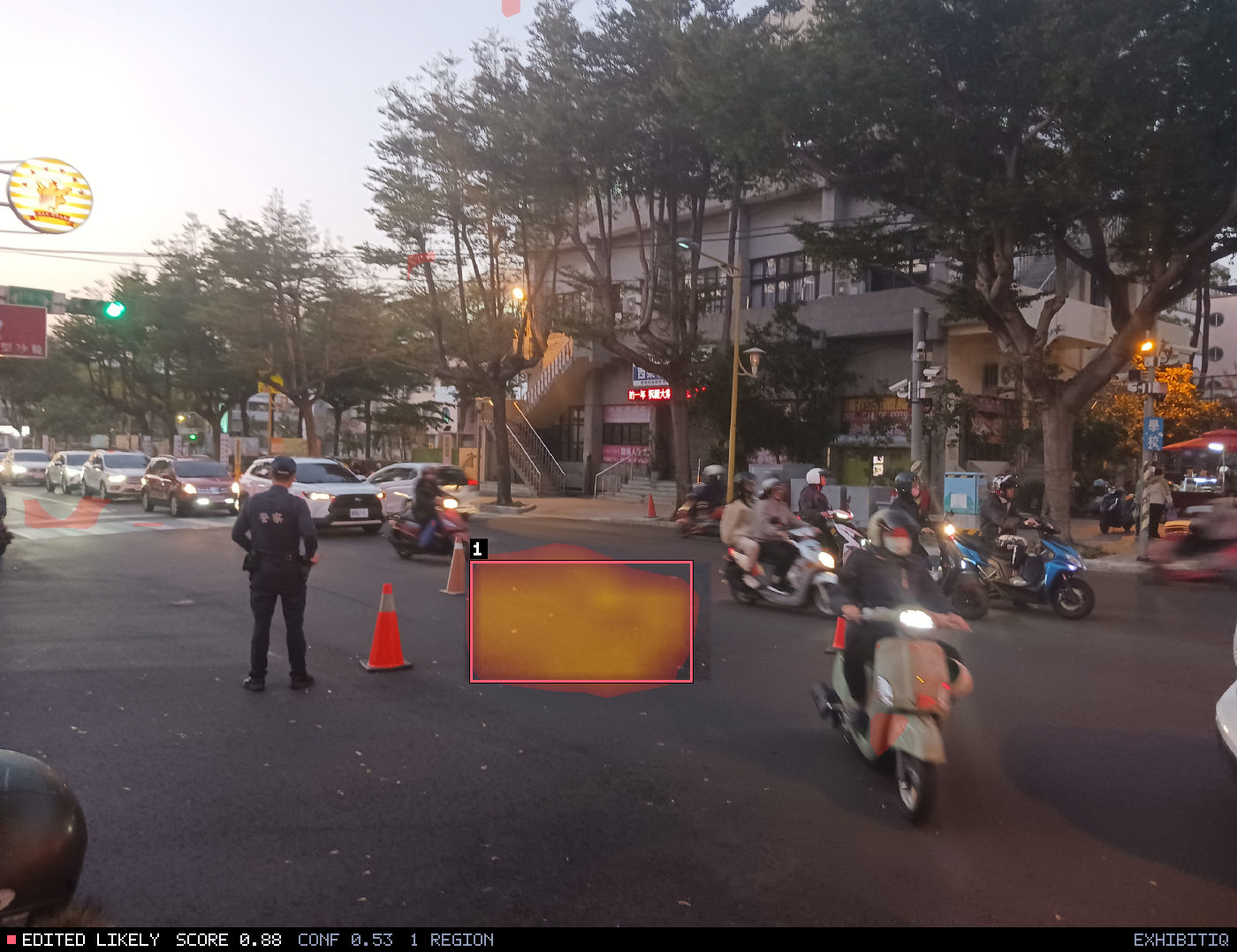
Five exhibits use real public-domain collision photos; the sixth is an AI-generated image. We made the alterations ourselves, then ran each file through the production engine without telling it what changed. Every reading and number below is what it returned, including Exhibits B and D, where it could not confirm the alteration.
The images shown here are resized web copies with no camera data. Uploading one of them to the live check will not reproduce the published result, which came from the full original file.
Check a photo now
Use one from a closed matter.
JPEG, PNG or WebP up to 8 MB. The image is analysed in memory and never stored. Takes about 20 to 40 seconds.
Read this before you rely on it
What ExhibitIQ is not.
A screening step that tells your team where to look. The attorney decides what the file says.
- Not an expert witness. A result is a weighted reading of evidence with a stated confidence. It never says "fraud" and it is not testimony.
- It misses things. Exhibits B and D above are alterations it read as inconclusive. A careful editor can pass single-image forensics; the client interview and the original device remain the backstop.
- It can flag an honest photo. A genuine picture that has been resized, re-saved or screenshotted can read as likely edited. A flag is a reason to get the original, not a conclusion.
- The public check is lighter. It runs without the vision-model read that the pilot and paid plans include.
- Inconclusive is common. Texted, screenshotted and heavily compressed photos lose the signals that would prove or disprove an edit. The result says so instead of guessing.
- Measured on a small set. The published exhibits are a handful of collision photos. A pilot on your own closed matters is how you find out how it reads your files.
- Client files leave your office. Photos are processed on Cloudflare under Ward Tech Systems' account. Originals and marked-up images expire after 90 days; findings and hashes stay until you delete the matter. The privacy policy and terms are current drafts. A data-processing addendum is available on request.
Free pilot
30 days. 300 photos. Your own closed matters.
We set up a private portal for the firm and run a blind check on photos from closed cases you choose. If it finds nothing you did not already know, you have lost an afternoon. After the pilot, plans start at $499 a month for 2,500 photos.